Recommendation AI
Recommending food is easy — until a wrong suggestion triggers an allergic reaction. A conversational recommendation system that treats safety as a separate, non-negotiable check: a reasoning-and-acting (ReAct) orchestrator drives a 4-stage recommender — learned two-tower retrieval, a learned ranker, sequential modeling, and a path into generative retrieval with semantic IDs. An independent hard-constraint safety layer screens every candidate before it surfaces, recording why each was kept or excluded. Recall@K and NDCG evaluation gates every change across the full pipeline.
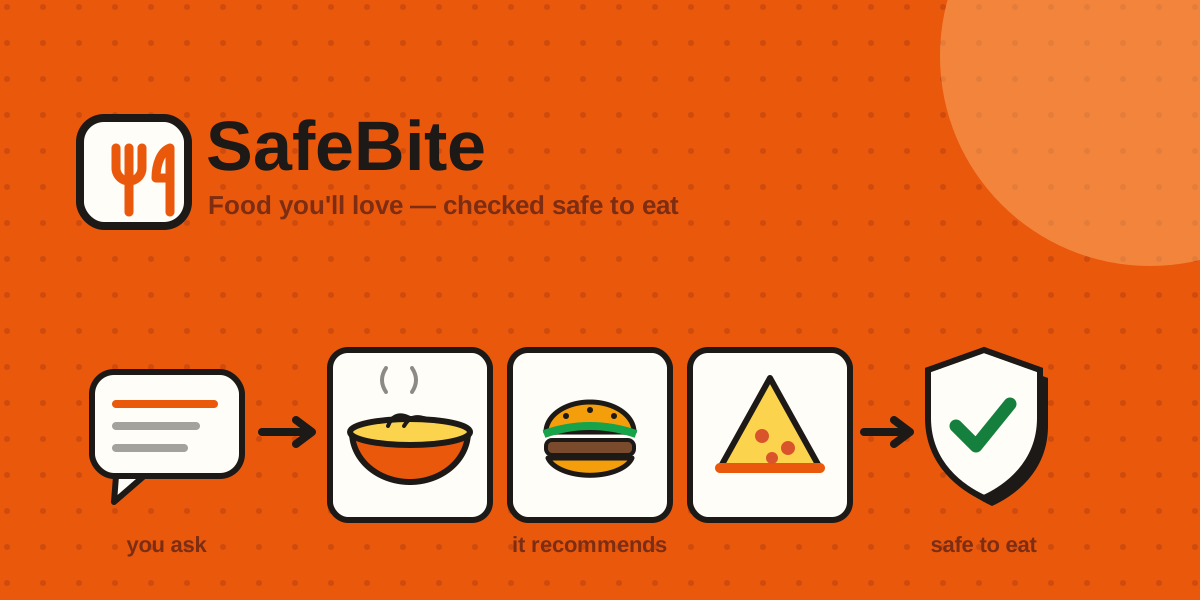
Recommending food is easy — until a wrong suggestion means an allergic reaction. SafeBite treats "is this safe for you" as a separate, non-negotiable stage, not a guess folded into the recommendation. SafeBite pairs a conversational, agentic interface with a production recommendation engine. A reasoning-and-acting (ReAct) orchestrator interprets the conversation, calls the recommender, and explains each suggestion in context. The recommendation engine takes the shape modern large-scale recommenders take: learned two-tower retrieval to narrow a large catalog, a learned ranking model to order the shortlist, sequential modeling to capture what a user will want next, and a path into generative retrieval with semantic IDs. Throughout, hard-constraint screening is handled as an independent stage — every candidate is checked against the user's restrictions, with a record of why it was kept or excluded, before it reaches the conversation. Offline evaluation (Recall@K, NDCG) measures every change, so quality is proven rather than assumed.
Conversational recommenders are good at suggesting what a user might like, but they rarely treat hard safety constraints as a first-class concern, and most stop at simple similarity rather than the learned, measurable recommendation stacks used at scale. When constraint enforcement is folded into the same model that optimizes for preference, two objectives that can conflict are collapsed into one — and the system can give no account of why a candidate was treated as safe.
SafeBite separates the concerns and builds each one properly. A multi-stage recommendation engine — learned two-tower retrieval, a learned ranker, sequential modeling, and a path into generative retrieval — proposes and orders candidates; a ReAct orchestrator manages the dialogue; and an independent safety layer adjudicates the user's hard constraints, attaching a clear rationale to every decision. An offline evaluation harness (Recall@K, NDCG) gates every change.