← Back to Research
Trustworthy, Uncertainty-Aware Short-Term Electricity Load Forecasting

Trustworthy, Uncertainty-Aware Short-Term Electricity Load Forecasting

Energy Forecasting AI

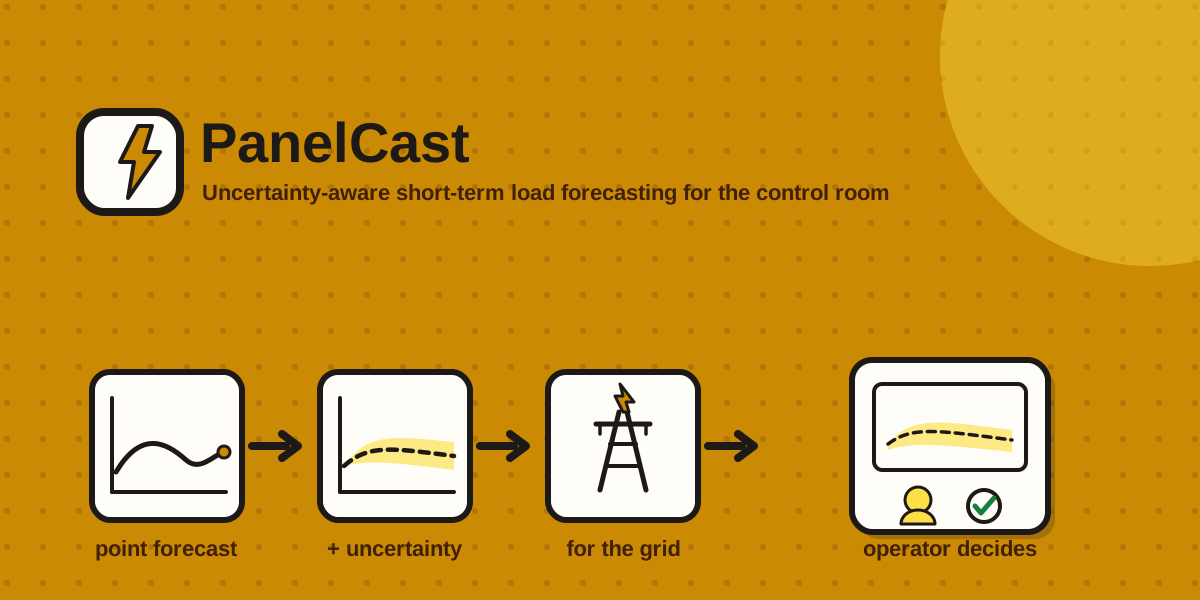
Grid operators schedule generation and hold reserves against a forecast of tomorrow's electricity demand, but a single point forecast hides what a dispatch decision actually needs: how wrong it could be, and when. This research asks how a forecasting system can report honest, trustworthy uncertainty that still holds up when demand shifts into an unusual regime, framed as decision support for the control room rather than autonomous dispatch.

Multi-AgentLoad ForecastingProbabilistic ForecastingCalibrated UncertaintyEnergyOperator Decision SupportEvaluation

The crisis

  • Electricity load forecasts drive generator scheduling and reserve procurement; when the forecast is wrong and its uncertainty is unstated, the grid either over-provisions (wasting fuel, money, and carbon) or under-provisions (risking shortfalls and outages).
  • A point forecast reports a single number and hides the one thing an operator's decision actually depends on — how uncertain that number is, and under which conditions it becomes unreliable.
  • Variable renewables, electrified heating and transport, and more frequent extreme-weather regimes are making demand more volatile, so forecast uncertainty is rising precisely as the cost of mis-estimating it rises.
  • Most uncertainty methods report a wider band when unsure but cannot act to reduce that uncertainty; and most produce intervals whose stated confidence is not the confidence you actually get under distribution shift.
  • As AI systems increasingly mediate grid operations, honest, coverage-guaranteed, auditable uncertainty — not just accuracy — is what decides whether a forecast can be trusted in the control room.

About this research

Short-term electricity load forecasting is treated here as a problem of honest uncertainty rather than point accuracy alone: a dispatch decision depends not only on the predicted demand but on how trustworthy that prediction is, especially when demand enters an unusual regime such as a heat wave, holiday, or cold snap. This thread investigates how a forecasting system can produce calibrated, well-behaved uncertainty that means what it says under shifting conditions, and how such a system can act to reduce that uncertainty rather than only report it, while keeping the whole process auditable. It is framed throughout as operator decision support that drafts a calibrated recommendation; a human keeps final say on dispatch. The work draws on probabilistic forecasting, uncertainty quantification, agentic LLM systems, and rigorous evaluation on public energy data. Faculty-advised.