Statistical Methods
Links quantile statistics and mean absolute deviations: MAD-based shape metrics as integrals of the quantile function with clear geometry. Midpoint quadrature recovers IQR, Galton skewness, and Moore octile kurtosis; a C-Trapezoid rule cuts approximation error and supports closed-form, outlier-resilient parameter estimation (12.5% breakdown per tail).
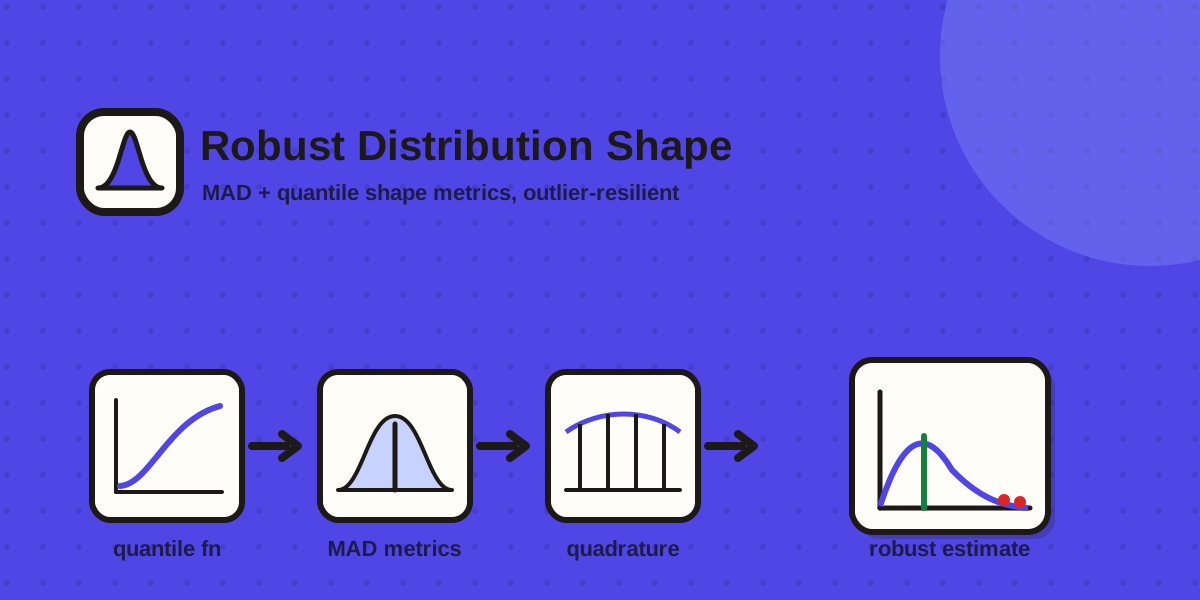
We connect quantile functions and mean absolute deviations by deriving MAD-based shape metrics expressed as integrals of the quantile function, with a direct geometric reading. The framework covers distributions with finite mean, including cases without finite variance (e.g. Pareto). With midpoint quadrature, the construction recovers standard quantile-shape summaries (interquartile range, Galton skewness, Moore octile kurtosis). We introduce a C-Trapezoid quadrature rule (cubic endpoint extrapolation plus trapezoidal integration) that sharply lowers approximation error versus the midpoint rule on common distributions, and yields closed-form, non-iterative estimation formulas where no closed-form CDF exists — with stronger outlier resilience than MLE (12.5% breakdown per tail). Two case studies illustrate quick distributional shape assessment without specialized tooling.
Can a single MAD-based family of distribution-shape metrics, expressed as integrals of the quantile function, recover the standard quantile-shape summaries as special cases — and can a simple cubic-endpoint quadrature rule approximate them accurately enough to yield closed-form, outlier-resilient parameter estimates for distributions that may lack a finite variance or an explicit CDF?
MAD-based shape metrics are derived as integrals of the quantile function with a direct geometric (subarea) interpretation. Midpoint quadrature over octiles is shown to recover the interquartile range, Galton skewness, and Moore octile kurtosis as special cases. A C-Trapezoid rule (cubic-polynomial endpoint extrapolation combined with trapezoidal integration) is introduced and its approximation error compared against the midpoint and rectangle rules across common continuous distributions, including heavy-tailed cases without finite variance (e.g. Pareto). Closed-form, non-iterative octile-based estimators are derived and contrasted with maximum likelihood, quartile fitting, and L-moment estimation, and illustrated with two case studies.